

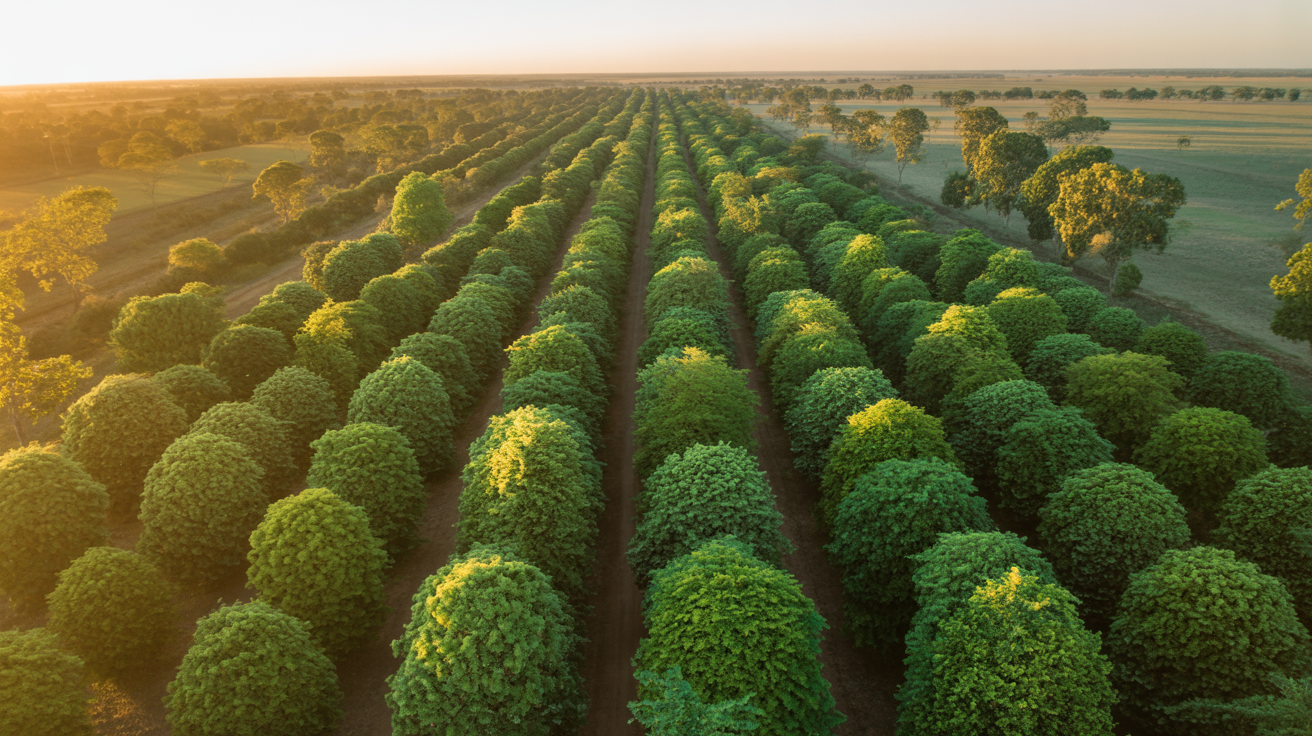
Why Moringa Is the Future of Sustainable Biofuels in Australia
The global push toward decarbonisation has placed renewable fuels at the centre of Australia's energy strategy. As the nation works to reduce emissions across aviation, freight, mining and agriculture, one plant is emerging as a genuinely transformative feedstock: Moringa oleifera. With the Australian biofuel market projected to reach A$9.5 billion by 2034, moringa offers a rare combination of high oil yield, climate resilience and whole-plant economics that few other crops can match.
The Feedstock Advantage
Moringa seeds contain between 38 and 42 percent oil, placing them among the most productive oilseed crops available for biodiesel and sustainable aviation fuel. The oil is rich in oleic acid, which produces a high-quality fuel with excellent cold-flow properties, strong oxidative stability and a high cetane number. These characteristics allow moringa biodiesel to meet the demanding ASTM D6751 and EN 14214 international fuel standards without extensive additional treatment.
Unlike many first-generation feedstocks, moringa is a fast-growing perennial tree. Once established, a plantation can be harvested repeatedly over many years, delivering a reliable and renewable supply of seed without the need for annual replanting.
A Second-Generation Feedstock Beyond the Food versus Fuel Debate
A common criticism of biofuels is that they compete with food production for prime agricultural land. Moringa sidesteps this concern. It thrives on marginal and degraded soils, including rehabilitated mining land, where conventional food crops struggle. This means moringa can expand Australia's fuel production capacity without displacing food agriculture or clearing native vegetation.
The Economic Game Changer: Negative Cost Fuel
What truly sets moringa apart is the whole-plant utilisation model. Every part of the tree carries value. The seed oil becomes biodiesel and aviation fuel, while the residual seed cake, leaves and other biomass feed a portfolio of high-value co-products spanning stock feed, organic fertiliser, cosmetic-grade seed oil, superfood powder and nutritional products.
Together these co-products generate revenue of approximately A$530 per barrel, more than nine times the underlying production cost of around A$58 per barrel. The result is what MorFuels describes as a negative cost fuel model, where co-product income effectively subsidises the fuel itself. This structural advantage is unique in the Australian biofuels industry and underpins the exceptional resilience of the business case.
Perfectly Suited to the Australian Climate
Moringa is a tropical and subtropical species that flourishes in warm, dry conditions. The Gympie to Bowen corridor in Queensland offers close to ideal growing conditions, with abundant sunshine, suitable rainfall and large areas of available land. The tree's deep root system gives it strong drought tolerance, while its nitrogen-fixing qualities improve soil health over time, reducing the need for synthetic inputs.
Powering Aviation's Path to Net Zero
Aviation is one of the hardest sectors to decarbonise, and sustainable aviation fuel is central to the industry's climate commitments. Moringa oil can be processed through the Hydroprocessed Esters and Fatty Acids pathway, the only commercially deployed and ASTM D7566-certified route to SAF in use today. HEFA-based SAF can cut lifecycle greenhouse gas emissions by up to 80 percent compared with conventional jet fuel and can be blended at up to 50 percent with standard aviation fuel without any engine modification.
The Road Ahead
MorFuels is establishing a 1,000 hectare pilot plantation as Phase 1 of a staged expansion designed to scale toward one million hectares over time. As global demand for low-carbon fuel accelerates and government policy increasingly favours domestic production, moringa is well positioned to become a cornerstone of Australia's renewable fuel future. It delivers energy security, regional employment, measurable emissions reductions and a compelling commercial return, a combination that few other feedstocks can offer.