

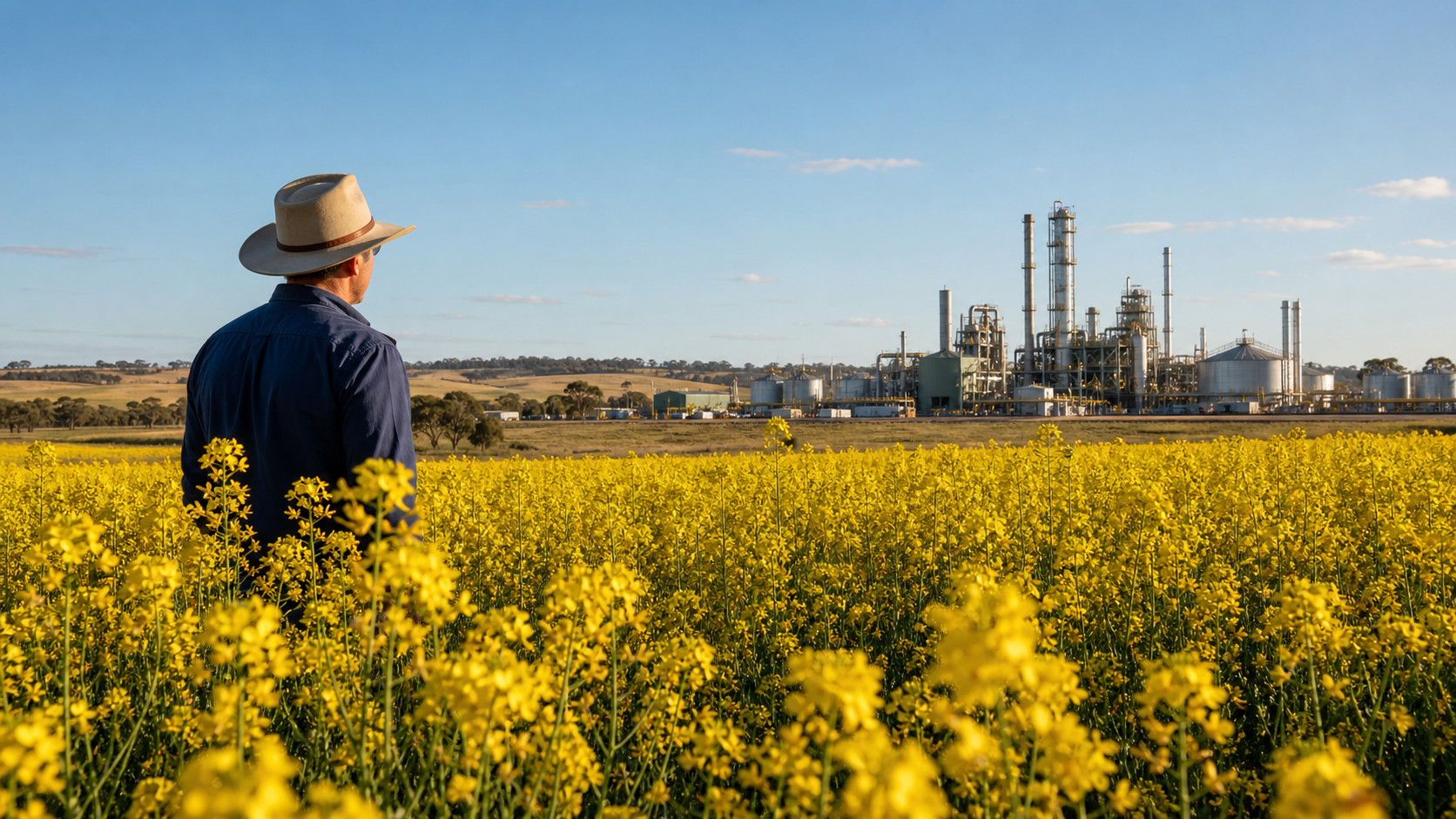
Feedstock First: GRDC's Low-Carbon Liquid Fuels Roadmap for Australian Grain Growers
The Grains Research and Development Corporation has released its Low-Carbon Liquid Fuels Roadmap, a strategy document that positions Australian grain growers at the centre of the global transition to renewable fuels. Titled Feedstock First, the roadmap makes a compelling case: the next oil boom will not come from beneath the ground, but from the farm. For MorFuels and the broader Australian biofuels sector, the implications are significant and deeply encouraging.
Why Feedstock Is the Starting Point
Renewable fuels, referred to in the roadmap as low-carbon liquid fuels, will be a mainstay of the future global energy mix. As more countries introduce supportive policies and scale up production, competition for available feedstocks is intensifying. GRDC argues that Australia's grain growers are uniquely positioned to meet this demand, particularly through oilseed crops processed via the HEFA pathway, the most commercially proven and scalable route to biodiesel, renewable diesel and sustainable aviation fuel. By 2030, more than 85 percent of announced global low-carbon liquid fuel production capacity is set to use HEFA technology with fats, oils and greases as feedstock.
The Scale of the Opportunity
Australia already produces a significant exportable surplus of plant oils. Canola production has grown from a five-year average of less than 2 million tonnes in the early 2000s to more than 6 million tonnes in 2025, with around 75 percent exported, much of it already destined for renewable fuel processing overseas. The country produces a surplus of 4 to 5 million metric tonnes of canola grain containing over 2 million tonnes of oil feedstock. The roadmap argues that this surplus, combined with the potential to expand production of other oilseed and biomass crops, gives Australia a natural feedstock advantage that few other countries can match.
Three Horizons of Innovation
The roadmap lays out a phased strategy across three development horizons. Horizon 1 focuses on expanding oilseed cropping within the existing farming footprint: increasing the area planted to canola, revisiting drought-tolerant alternatives like Brassica juncea (Indian mustard), incorporating intermediate cover crops and reviving minor oilseeds such as sunflower, safflower and linseed. Horizon 2 targets intensified oil production by breeding higher oil content into existing crops, including a particularly exciting Australian opportunity in narrow-leafed lupin, a nitrogen-fixing legume once grown on more than 2 million hectares that could be engineered to produce over 30 percent oil. Horizon 3 looks further ahead to Biomass Oil crops, a breakthrough Australian technology that converts vegetative plant tissue, leaves and stems, into oil factories, achieving up to 35 percent oil accumulation in laboratory trials and opening the door to massive new feedstock volumes without additional land use change.
Carbon Intensity as a Competitive Edge
Not all feedstocks are equal, and the roadmap makes clear that carbon intensity will increasingly determine market access and price premiums. Carbon intensity measures the total greenhouse gas emissions across the fuel lifecycle, from production inputs and logistics to processing and refining. Feedstocks with lower carbon intensity scores are preferred by end users and attract higher prices. Australian growers have real opportunities to reduce their carbon intensity through practices such as using low-emission fertilisers, growing nitrogen-fixing legumes, adopting cropping system intensification, and minimising indirect land use change. These sustainability credentials can become a genuine competitive advantage in global feedstock markets.
Hard-to-Electrify Sectors Need Liquid Fuels
The roadmap reinforces a point that is central to the MorFuels thesis: many critical sectors of the economy cannot be electrified quickly or cost-effectively. Aviation, marine transport, mining, heavy road freight, rail and agriculture all depend on liquid fuels and will continue to do so for decades. According to the International Energy Agency, demand for low-carbon liquid fuels in these hard-to-electrify sectors is expected to accelerate from 2030. Renewable fuels are compatible with existing internal combustion engines as drop-in alternatives, delivering immediate emissions reductions without waiting for entire fleets to be replaced.
Building a Domestic Industry
Despite its natural advantages, Australia has not yet seized the opportunity to build its own large-scale low-carbon liquid fuel production industry. The roadmap notes that without a much larger domestic capability, the country will continue its heavy reliance on imported, high-emission petroleum fuels, prolonging fuel security risks. Domestic production would underpin fuel sovereignty, create regional jobs and redirect money currently paid to foreign petroleum supply chain participants into Australian communities, benefiting feedstock growers, logistics providers, biomass processors and fuel distributors.
From Waste Oils to Purpose-Grown Crops
The roadmap describes a clear feedstock evolution. In the short term, waste feedstocks such as tallow and used cooking oil have very low carbon intensity and are the first preference for HEFA processing, but their volumes are limited. Established seed oils like canola and soybean are more available and scalable but carry higher carbon intensity. As intensified seed oils with reduced carbon intensity become available, and ultimately as Biomass Oil crops are commercialised, the feedstock stack deepens and diversifies. This progression mirrors the MorFuels approach, which uses moringa, a purpose-grown, high-oil tropical oilseed crop, to supply a dedicated biorefinery rather than relying on constrained waste streams.
An Integrated Value Chain
The roadmap envisions a fully integrated value chain from primary production through storage, handling, primary processing (fractionation into oil and co-products), refining to low-carbon liquid fuels, and distribution to end users in aviation, marine, mining, road and agriculture. Marketing, advisory, brokerage and risk management services sit alongside this chain. For grain growers, the message is clear: producing feedstock for renewable fuels is not a side venture, it is a core enterprise opportunity that fits within and strengthens existing cropping systems.
What This Means for MorFuels
The GRDC roadmap validates several pillars of the MorFuels strategy. It confirms that HEFA is the dominant and most cost-effective pathway for biodiesel and sustainable aviation fuel, exactly the route MorFuels employs. It highlights the importance of purpose-grown, low carbon intensity feedstocks, precisely what moringa delivers with its high oil content, minimal input requirements and ability to grow on marginal and rehabilitated land. And it underscores the urgency of building domestic production capacity before Australia's feedstock advantage is captured entirely by overseas processors. As Australia's grain growers prepare to supply the next generation of renewable fuel feedstocks, MorFuels is building the refining infrastructure to turn that feedstock into the low-carbon liquid fuels the country needs.