

Beyond Fuel: Moringa as a Bio-Based Material for Water Treatment and the Circular Economy
A comprehensive review published in the Chemical Engineering Journal: Green and Sustainable (2026) has mapped the remarkable breadth of Moringa oleifera as a bio-based material for environmental remediation and circular economy systems. Drawing together evidence from more than 4,500 scientific publications spanning 1960 to 2025, the open-access review positions moringa not as a single-purpose crop but as an integrated bioresource sitting at the interface of clean water, nutrition, medicine and sustainable development. For MorFuels, whose whole-plant model already extends far beyond fuel, the review is a powerful independent affirmation of the circular economy thinking at the heart of our business.
A True Zero-Waste Crop
The review's central theme is moringa's capacity for zero-waste utilisation. Every part of the tree carries value. Leaves serve as nutritional supplements and animal feed, seeds yield oil and act as a natural water coagulant, and the seed cake left after oil extraction becomes animal feed, organic fertiliser or a feedstock for further processing. This cascading use, reduce, reuse and recycle, is the defining principle of the circular economy, and moringa embodies it more completely than almost any other crop.
Nature's Water Purifier
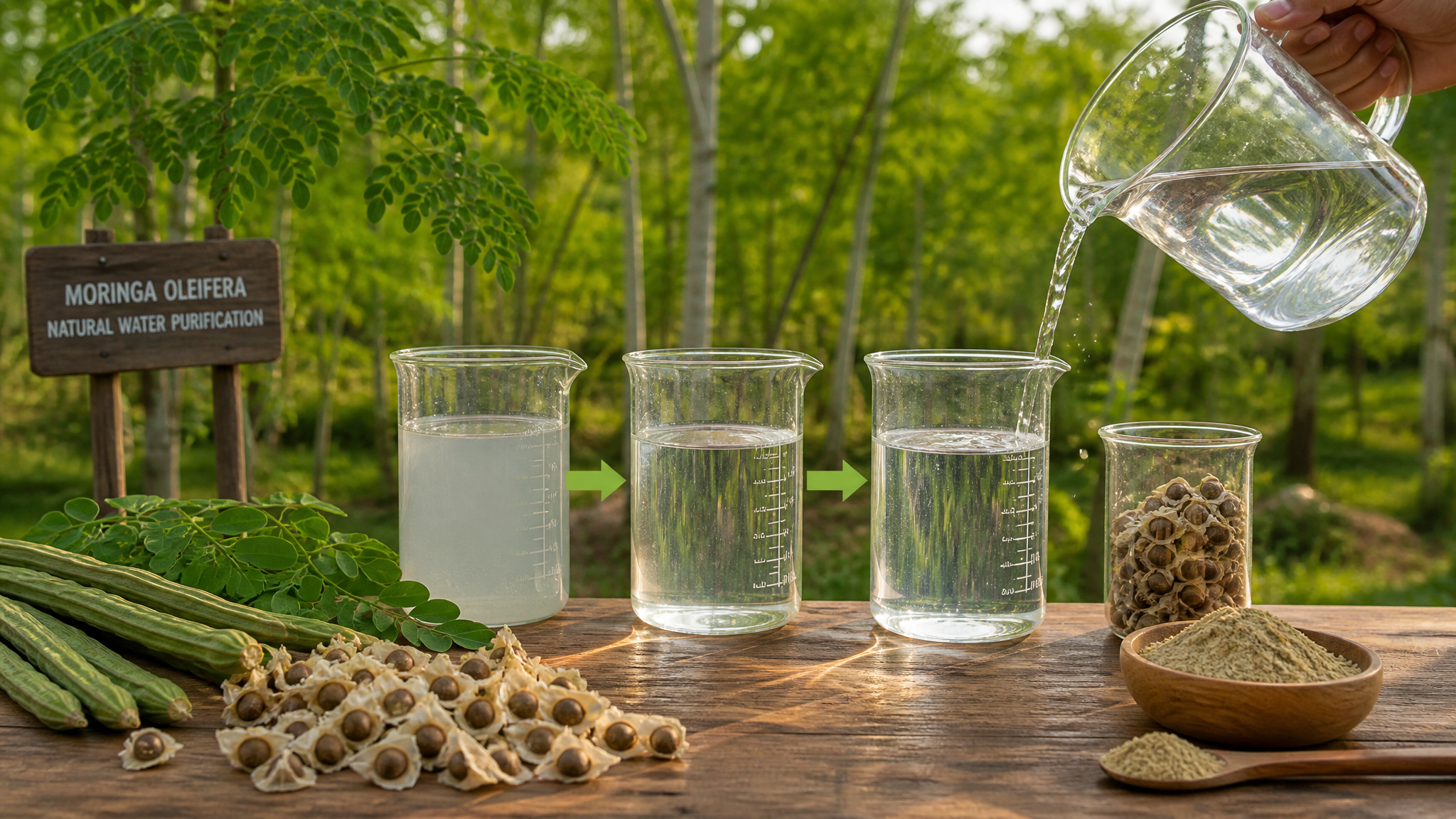
One of the most striking applications documented in the review is moringa's role in water treatment. Moringa seeds contain cationic coagulant proteins, ranging from 3 to 60 kilodaltons, that act as positively charged polyelectrolytes. These proteins attract and bind negatively charged contaminants, forming larger aggregates that settle out of solution and dramatically reduce turbidity, pathogens and heavy metals. Research shows moringa seed extracts can remove between 90 and 99 percent of turbidity from surface water at optimal doses, with a single shelled seed capable of treating roughly one litre of water.
Crucially, when combined with sand and biochar, salt-extracted moringa protein has been shown to reduce turbidity, E. coli and heavy metals to levels compliant with World Health Organization and UK drinking water standards. This offers a low-cost, biodegradable alternative to chemical coagulants such as aluminium sulphate, which produce hazardous sludge and carry human health risks.
Removing Heavy Metals and Pollutants
Beyond clarifying water, moringa demonstrates genuine pollutant-removal capability. Functional groups on the seed biomass, including amine, hydroxyl and carboxyl groups, facilitate the removal of dissolved heavy metals such as lead, cadmium, zinc and chromium through electrostatic interactions, hydrogen bonding, surface complexation and ion exchange. Moringa biomass can also be carbonised into biochar, which is effective at adsorbing toxic metals and treating greywater, closing yet another resource loop by turning residual material into an active environmental tool.
Exceptional Carbon Sequestration
The review highlights moringa's unusually high carbon dioxide absorption capacity, reported in Japanese studies to be up to twenty times that of conventional vegetation. Combined with rapid biomass accumulation and an extensive root system that enhances soil fertility, this positions moringa as a genuinely climate-resilient species for carbon sequestration and sustainable agroforestry. A mature tree can yield between 15,000 and 25,000 seeds each year, and the plant flourishes at altitudes up to 2,000 metres on rainfall as low as 250 millimetres.
High-Value Co-Products
The review reinforces the extraordinary versatility of moringa's outputs. Dry leaves contain around 29 percent protein, 2,185 milligrams of calcium and 25.6 milligrams of iron per 100 grams, supporting fortified foods and livestock feed. The seed oil, comprising 70 to 75 percent oleic acid along with tocopherols, supports stable cosmetic and skin-care formulations. Phytochemicals such as quercetin, isothiocyanates and glucosinolates underpin antimicrobial, anti-inflammatory, antidiabetic and anticancer properties. Even the oil-extraction residue can be combined with silicon oxide to produce a bio-lubricant with physical properties comparable to synthetic alternatives.
Validated by Life Cycle Assessment
Importantly, the review does not rely on enthusiasm alone. Life cycle assessment applied to moringa value chains confirms that by-product valorisation strengthens circular bioeconomy models and lowers overall environmental burden. The analysis identifies sustainability hotspots, such as energy use during processing, and shows how they can be mitigated by putting residual streams like seed cake to productive use as fertiliser, feed or water-treatment material. This is precisely the integrated, waste-minimising design philosophy that MorFuels applies at commercial scale.
Aligned With Global Development Goals
The authors map moringa's applications directly onto the United Nations Sustainable Development Goals, including zero hunger, clean water and sanitation, responsible consumption and production, climate action and life on land. Because moringa thrives on marginal land with minimal fertiliser, pesticide or irrigation inputs, it reduces pressure on natural resources while supporting rural livelihoods and food security, an outcome that resonates strongly with the regional development benefits central to the MorFuels vision.
What This Means for MorFuels
This review broadens the story beyond biodiesel and sustainable aviation fuel. It confirms that the same moringa plantations that supply our biorefinery can also underpin clean water solutions, soil restoration, carbon sequestration and a diverse portfolio of nutritional, cosmetic and industrial co-products. The circular, zero-waste model that MorFuels has built its business around is not a marketing concept. It is a scientifically validated pathway to environmental remediation and sustainable development, with independent research increasingly confirming that moringa is one of the most complete bioresources available to a decarbonising world.
Reference: Shah, A., Arjunan, A., Batool, M., Dhir, A., Arafat, A., Magaia, F., Manning, G., Zakharova, J., Abbas, N., Khan, H., Rubab, R. & Husnain, M. (2026). Moringa oleifera as a next-generation bio-based material for environmental remediation and circular economy systems. Chemical Engineering Journal: Green and Sustainable, 2, 100062. Published open access under the Creative Commons Attribution 4.0 Licence.